

By Douglas V. Gibbs ——Bio and Archives--November 20, 2026
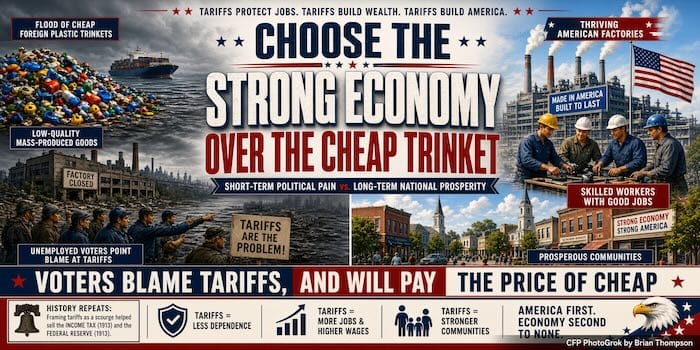
The midterms are nearly three weeks behind us and Republicans are already racing to write the wrong lesson. The favored explanation for the blue wave in some quarters is the Iran war and gas prices. A new J.L. Partners poll of 1,000 voters, commissioned by the Vandenberg Coalition, says otherwise: 22 percent, the single largest share, name tariffs and trade wars as "most responsible for the increase in the cost of living," ahead of the war at 20 percent, Washington corruption at 20 percent, and the Biden administration at 16 percent. Among Republicans who actually voted, only 13 percent blame the war.

The takeaway being peddled is that tariffs are a political liability, that the GOP should soften, hedge, and get back to promising cheaper stuff. Fine. But the poll doesn't tell us tariffs failed. It tells us the case for tariffs has never been made properly to the people paying for them.
Yes, prices on foreign goods went up. That was the point. A tariff is a deliberate surcharge on the cost of doing business somewhere other than here. If a company can stamp out a widget in Shenzhen for a fraction of what it costs in Ohio, no amount of flag-waving gets that factory built in Ohio. Only math does. Tariffs change the math.
I play golf. I have learned over my many years as a duffer on the courts that I can hit it straight, or I can hit it far. I don't typically get both. The swing that finds the fairway is not the swing that clears the bunker, and every player who has ever picked up a club has had to decide which one he wants badly enough. National economies work the same way. We can have dirt-cheap goods made by somebody else's workforce, or we can have somewhat more expensive goods and a country that still knows how to make things. You don't get both. Anyone promising both is selling you a golf swing that goes 350 and never leaves the short grass.
For my entire lifetime the political class has promised both, and delivered neither. Every cycle each party stands at a podium and blames the other for shipping the jobs overseas, and then both of them protect the arrangement that does it. Cheap imports are a subsidy to consumers and a tax on producers, and the producers lost. Whole towns emptied out. The tool-and-die shop became a self-storage lot. The workers retrained into warehouses and call centers, if they were lucky, and were told it was progress. Then the same people who engineered that outcome get on television and complain that nothing is made here anymore, as though the outcome were weather.

Economics is really simple when it comes to production and manufacturing. It's all about the cost of doing business, and the rules set it. Under the rules we had, producing overseas was cheap and producing domestically was expensive, so of course capital did what capital does. President Trump’s Tariffs simply rewrote the rules so that the reverse is now closer to true.
Consider the lumber industry, and note who did the tariffing. In 2024 the Biden administration, having spent months warning that Trump's tariffs would wreck everything, quietly raised the Canadian softwood lumber tariff to protect American mills from a flood of subsidized wood. By November, American output was climbing toward surpassing Canada's. Nobody called that inflation. Nobody called it a trade war. It was just a tool, used by people who claim the tool doesn't work.
The "tariffs are evil" reflex has a century of muscle memory behind it, and it was built for a reason. Before 1913, tariffs and a census-based apportionment on the states funded the federal government. At one point tariffs carried 95 percent of the load. Framing them as a scourge was useful to the people selling the income tax and the Federal Reserve. When the Depression came, the story that Smoot-Hawley caused it hardened into scripture, even though the Depression started before the bill passed. A century of repetition does not make a thing true. It just makes it unexamined.
Constitutionally, the objection is thinner than it sounds. The Founders themselves (Washington, Adams, Jefferson, Madison, Monroe) adjusted tariffs and negotiated tariff agreements without prior congressional sign-off. Presidents did it all through the nineteenth century. Theodore Roosevelt did it with Cuba. Wilson did it during the blockade. Hoover and FDR did it repeatedly before the Reciprocal Trade Agreements Act of 1934. Congress sets the schedule; the President conducts the negotiation. That is the design, and it long predates the emergency statute everyone is now litigating.
The cost of the old arrangement is not abstract. We run a trade deficit with China approaching $300 billion and depend on a communist rival for the goods a modern country ought to be able to make for itself. When someone says there's no American substitute for a given product, the correct reply is a one-word question: why? Why don't we make it? Why can't we compete? If the honest answer is "because their labor is cheaper and their rules are looser," then tariffs are the mechanism that closes the gap, and the only real alternative is to keep depending on them and hope they stay friendly.
What we owe voters isn't a retreat from tariffs. It's an honest accounting. Some prices went up, and that is a real cost, paid at the register by real people, and pretending otherwise insults them. But the other side of the ledger is factories, payrolls, apprenticeships, and supply chains that don't cross an ocean. Seventy-plus countries came to the table rather than eat the surcharge. That's leverage we didn't have before.
Republicans should stop apologizing for the policy in the stack that actually builds something. Choose the fairway. Choose the strong economy over the cheap trinket. And say so out loud, because the voters who blamed tariffs in that poll weren't rejecting the goal, they were waiting for someone to explain why the price is worth paying.
View Comments
Douglas V. Gibbs has been featured on Fox News Channel, One America News, and other television shows and networks. Doug is former AM/FM Radio Host of 15 years, and a longtime podcaster, conservative political activist, author, columnist and commentator. Doug can be reached at Douglasvgibbs.com.